What the policy actually says
As of our October 2026 check, Meta’s public Commerce Policies do not list homemade food as its own prohibited category. That is not a guarantee that a listing will stay up: Meta can remove listings under its policies, and state and local food rules apply whether a listing is visible or not.
In practice, Facebook Marketplace is one of the largest channels for informal home food commerce in the United States. A 2026 Almanac News investigation characterized Marketplace's food business as "thriving and largely unregulated," and a TASTE magazine piece titled "The Joys and Extreme Risks of Selling Food on Facebook" described sellers’ experiences with the platform.
A live listing is not evidence of permission from Meta or approval under your state’s food rules. Describe the actual product, price, and pickup details clearly, and check the rules that apply to your kitchen.
The practical takeaway is not "do not use Marketplace." It is "do not make Messenger and Marketplace your whole ordering system." Marketplace can create demand, but the order record, pickup window, payment/order status, and repeat-customer relationship need to live somewhere sturdier than a social inbox.
Buyers on Marketplace judge fast — photos, price, comments, consistency, and pickup details all signal whether you are credible. Some local buyers swear by homemade food from a neighbor; others will never order it. A listing that shows the actual food, a clear quantity and price, the pickup area and deadline, and what makes the product worth it does more than a clever caption. Repeatability helps too: post on a predictable day, use consistent product names, and keep payment and pickup details clean.
What home sellers actually sell there
The most common categories on Facebook Marketplace for home food in 2026:
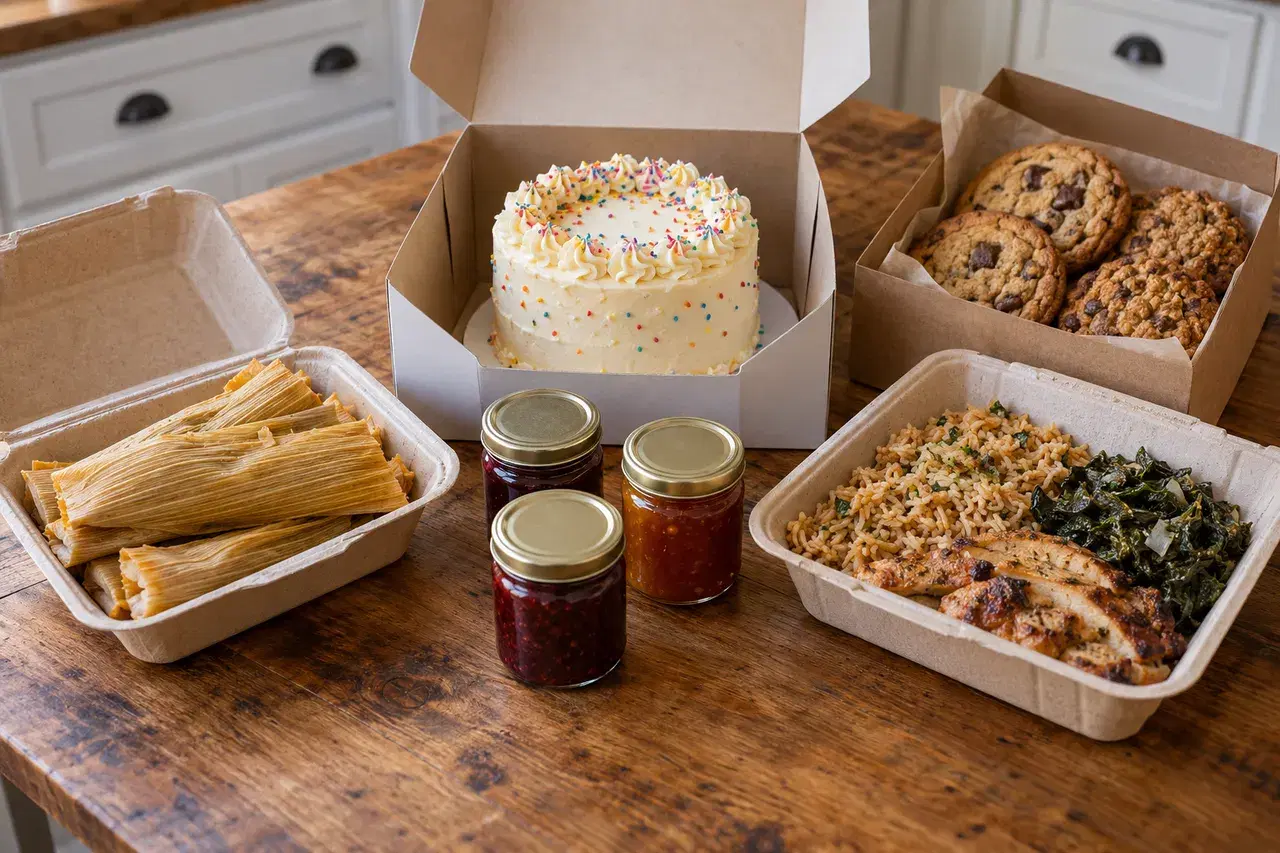
- Trending specialty items. Dubai chocolate strawberries became a 2025 phenomenon and moved substantial volume through Marketplace through the end of 2025 and into 2026. Custom cookies, specialty cakes, and regionally-specific foods (tamales, empanadas, biryani plates, soul food plates) run consistently across most markets.
- Plate sales. A cultural vernacular common in many communities — "selling plates from home" — describes home-cooked complete meals (often soul food, Caribbean, or similar hearty cuisines) sold in takeaway containers for a single price. This model runs heavily through Marketplace and local Facebook groups in many cities.
- Custom baked goods for events. Wedding cakes, birthday cakes, party trays, holiday cookies. This category has the highest average ticket of the common Marketplace food categories.
- Shelf-stable specialty goods. Jams, preserves, spice blends, roasted coffee, granola, hot sauces. Least likely to draw enforcement action; best-suited to Marketplace's static listing format.
- Weekend preorders. Order by Thursday for Saturday pickup, with limited quantities. This sits somewhere between a listing and a standing shop.
Pricing gets judged hard on Marketplace. Buyers compare your plate, dozen cookies, tray, or cake against restaurants, grocery stores, and other home sellers in the same feed. That does not mean you should undercharge. It means your listing needs to show what justifies the price: portion size, photos, pickup timing, custom work, ingredients, packaging, and whether the order is made fresh for a specific day.
For a cookie box or baked-goods listing, check the numbers in the baked goods pricing calculator before matching another seller's price. When a buyer is ready, use the bakery order form to collect quantities and pickup details in one place.
Marketplace post
A stronger listing moves serious buyers into an order path
Saturday pickup: tamales, tres leches cups, and party trays.
Order cutoff Thursday 8 PM. Pickup Saturday 10-1 near Montgomery Village.
Use the order link for quantity, pickup window, and payment/order details.
Limited quantity. Repeat buyers can use the same link every week.
Marketplace gets the post seen. The order link keeps quantity, pickup, contact, and payment/order clarity in one place.
Selling Plates from Home
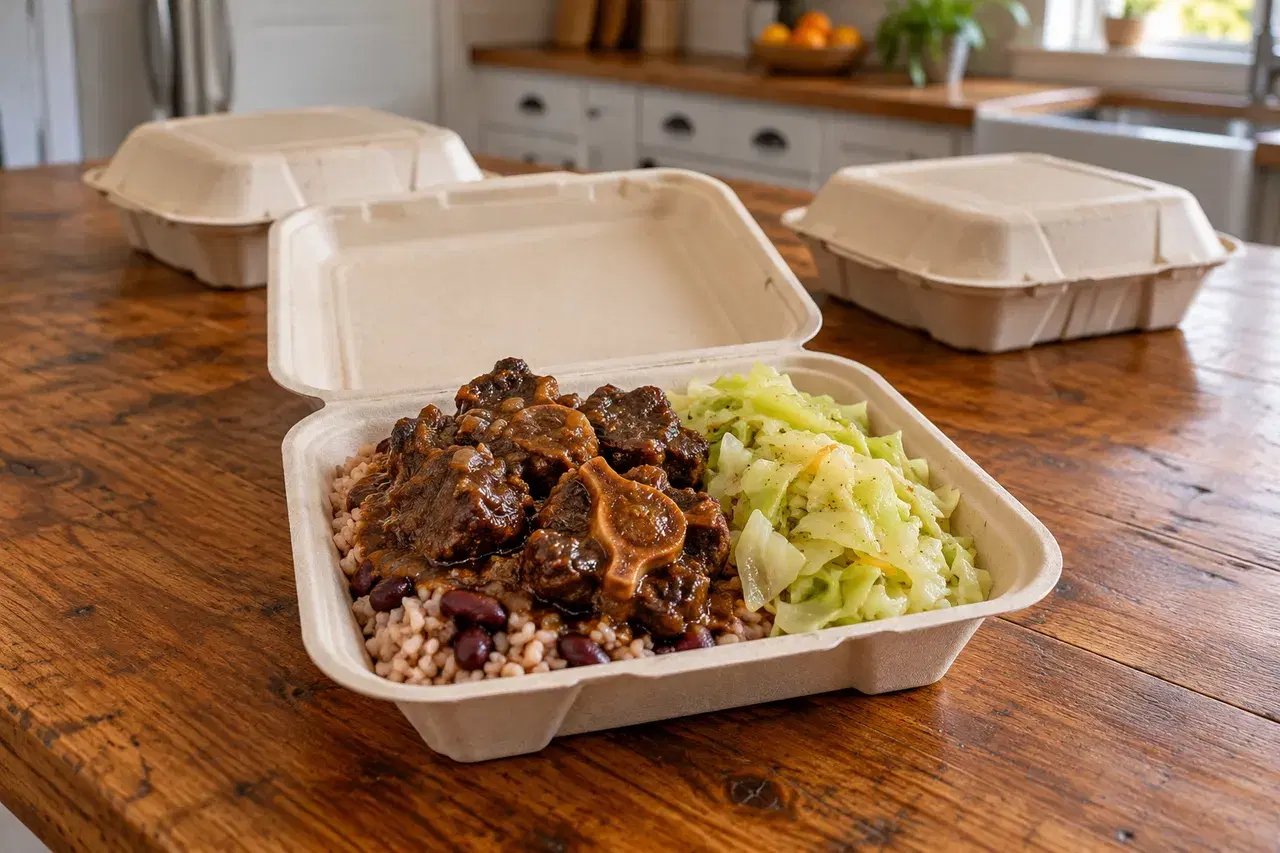
"Selling plates" is its own thread in the home-food economy. The vernacular comes out of HBCU campuses and soul-food traditions — batch-cooked complete meals (wings and rice, oxtails, fried fish, jerk chicken pasta, birria plates, biryani) portioned into takeaway containers and sold at a flat per-plate price. It has been a community practice for decades and has picked up substantial TikTok presence over the last two years, with creators documenting setups, menus, and weekly income. A lot of what moves through Facebook Marketplace's food listings in the US is plate sales.
The regulatory picture for plate selling is different from baking, and it is worth understanding how it actually works so you can make informed decisions without pretending the channel does not exist.
Most US state cottage food laws are written around shelf-stable foods — baked goods, jams, preserves, dry mixes, candies. Cooked meals and other time-and-temperature-sensitive foods (TCS foods in regulatory shorthand) usually sit in a different regulatory space. A growing set of programs explicitly cover home-cooked meal sales: California's MEHKO (microenterprise home kitchen operation) permit is the most established, with pilot or active programs in Utah, Montana, Oregon, and a handful of other states as of 2026. California MEHKO is the most-developed framework if you are in an opted-in California county, and the state summaries identify the listed prepared-food paths and their agencies.
In states without a specific cooked-meal permit framework, plate selling commonly runs within personal networks and word-of-mouth channels — neighborhood groups, workplace circles, campus networks, cultural community chats. This is how home-cooked food has moved in communities for generations. The landscape is actively evolving; more states are piloting permit tracks for cooked-home-meal sales every year. Checking your state's current rules directly (via your state department of public health or agriculture) is worth doing if you want to know what's available where you are.
For the announcement, order deadline, and pickup-day checklist, follow the plate sale guide.
The state-rule question is separate from the platform question
Facebook's policy is one thing. Your state's food rules are a separate thing that applies whether or not Facebook enforces its own policy. A listing that Facebook tolerates can still fall outside your state's cottage food rules if the food is on a restricted list, if you have exceeded your revenue cap, or if you need a different permit track.
Many home sellers who operate on Marketplace are selling foods that fit their state's cottage food rules. Others are selling prepared meals, plates, or hot items that may live under a different state/local path or an informal network. The state-by-state reference lists foods, limits and sales channels so you can compare it against what you actually sell.
Two specific intersections worth knowing:
- Third-party delivery is often a separate question. Most state cottage food laws are written around seller delivery or buyer pickup. Listing on Marketplace and arranging a third-party courier can bump into state rules even when the listing itself stays online.
- Interstate sales usually move outside cottage food. Marketplace exposes listings to buyers across state lines. A delivery across a state border can trigger federal food-safety regulations that cottage food law does not cover.
Why Messenger falls apart past the first handful of orders
Facebook Marketplace transactions fall back to Messenger by default. Payment is via whatever method the seller and buyer agree on — Venmo, Cash App, Zelle, cash, occasionally PayPal. None of this is managed by Facebook.
For the first few orders, this is fine. Past roughly 10 to 15 orders per week, it breaks down. The failure modes, which show up in home-seller community forums regularly:
- Orders get lost between Messenger and memory. Messenger conversations mix order messages with general chat, comments from buyers who never bought, questions from people who were window-shopping. Finding the specific thread with specific pickup-time agreement from a specific buyer, two weeks later, is not a reliable operation.
- Payment confirmation is manual. You have to check Venmo, check Zelle, check Cash App, cross-reference with the Messenger thread. Double-payments happen. Missing-payments happen. Disputes happen.
- Pickup coordination is a separate conversation. There is no shared calendar. The buyer's "I'll pick up Saturday morning" and your "OK, Saturday between 10 and 11" live in Messenger thread history and are easy to lose track of as volume grows.
- No repeat-order mechanic. Every order starts from scratch. The buyer who ordered cookies two weeks ago has no record on your end of what they ordered, what their dietary restrictions were, or how much they paid.
- Scaling means more Messenger chaos, not less. Doubling your volume doubles the Messenger surface area without any structural help.
Answer “is this still available?” with the order link
Prepare the listing and the reply together. The Facebook Marketplace Listing Kit gives you listing fields, a food-first hero image, and reply text that points to your order link. Check the food, price, pickup details, and link before you use it.
- Marketplace auto replies: when you create a listing, Meta AI can draft an automatic answer to availability questions from your listing details. You can turn it on, preview it, and edit it (Meta's Marketplace announcement, March 2026, accessed October 11, 2026), so you can use the kit's text with your order link instead.
- Saved replies: if you sell from a Facebook Page, saved replies now live in Meta Business Suite (Facebook's help page, accessed October 11, 2026). Save the kit's reply there.
- If you have neither, keep the reply in your phone's notes and paste it yourself.
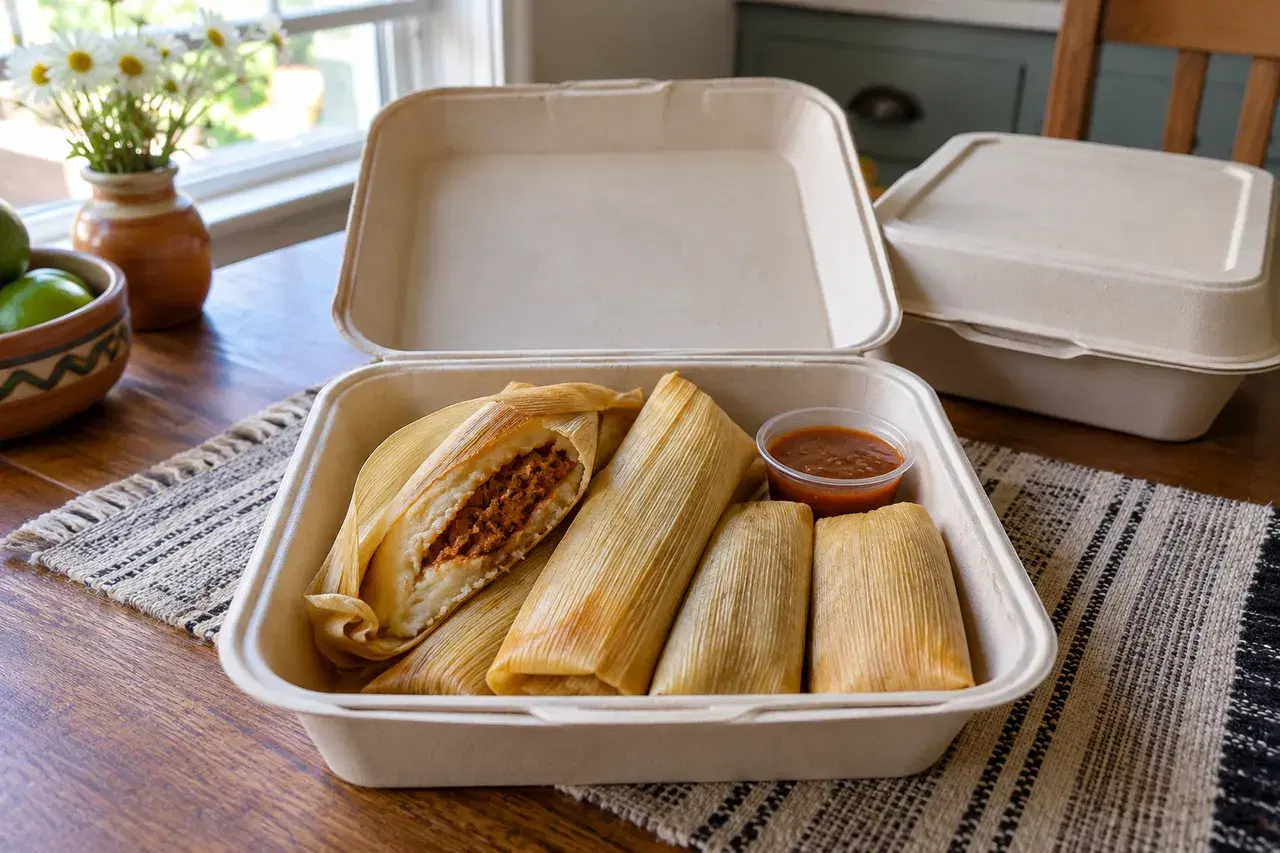
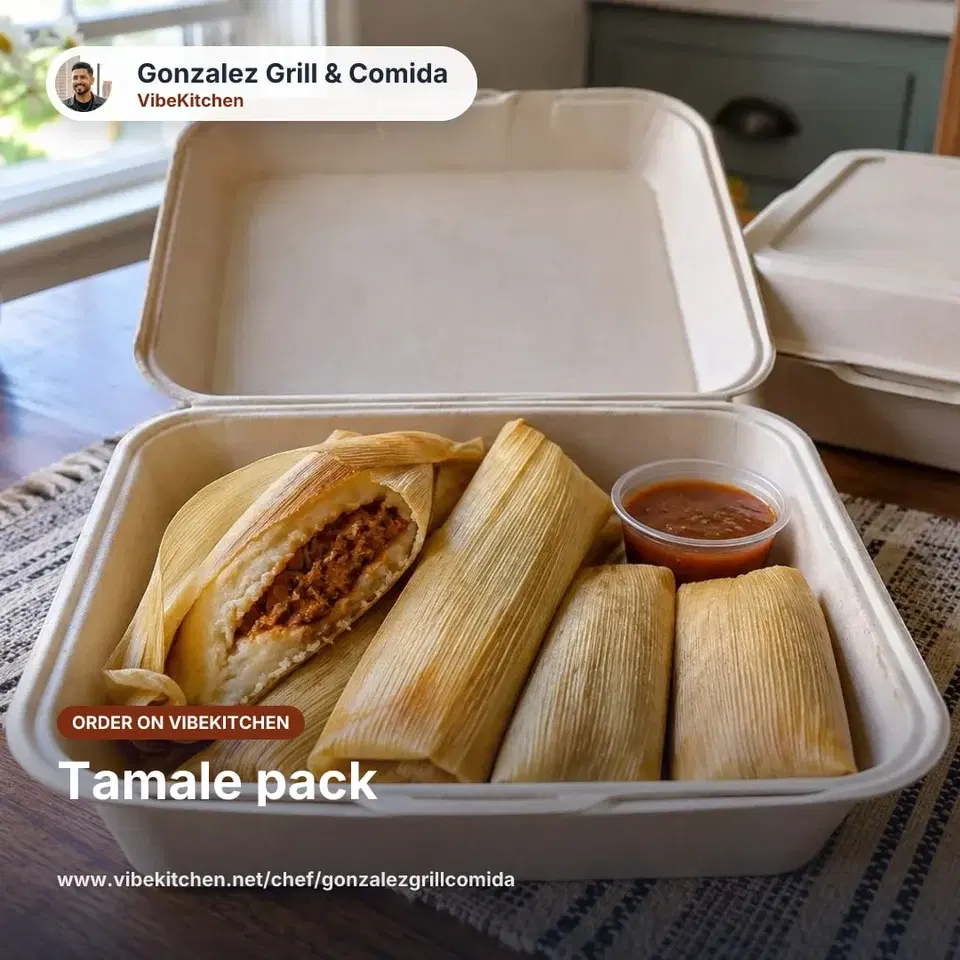
Worked example: someone asks whether your Saturday tamale pack is available. Open the order page first. If ordering is still open, send a reply naming the pack and pickup window with the link to buy. If it has closed, say so; don't reuse an old “yes” reply.
VibeKitchen does not read or answer your Facebook messages. It prepares the text and images; you publish the listing and choose Facebook's reply settings.
Sample shop
The Marketplace Listing Kit
From a sample shop, using the tamale pack from this guide.
The hero image
A food-first image for the listing, with your store name.
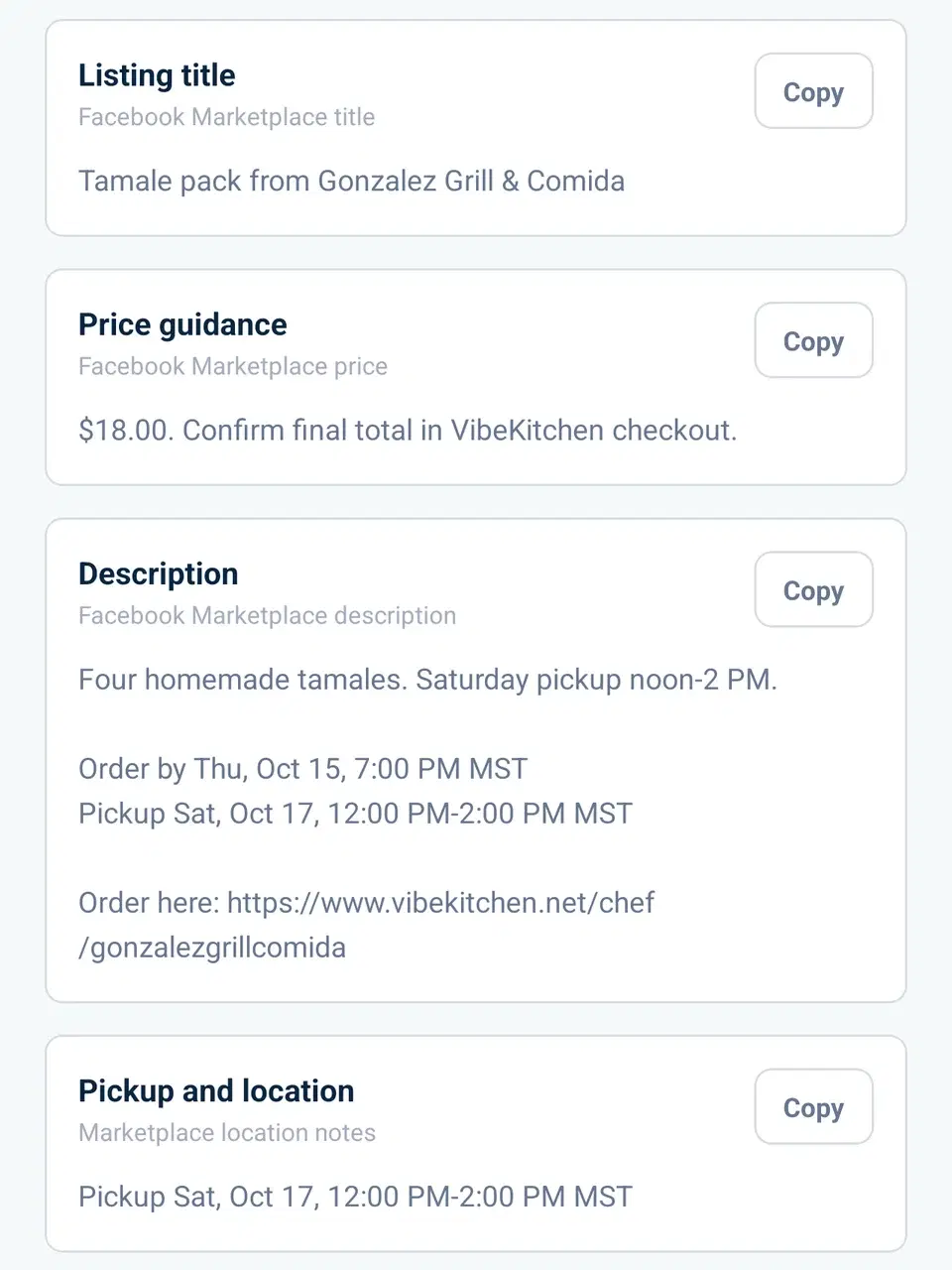
The listing fields
Title, price, description and pickup note, with the deadline and pickup window filled in.
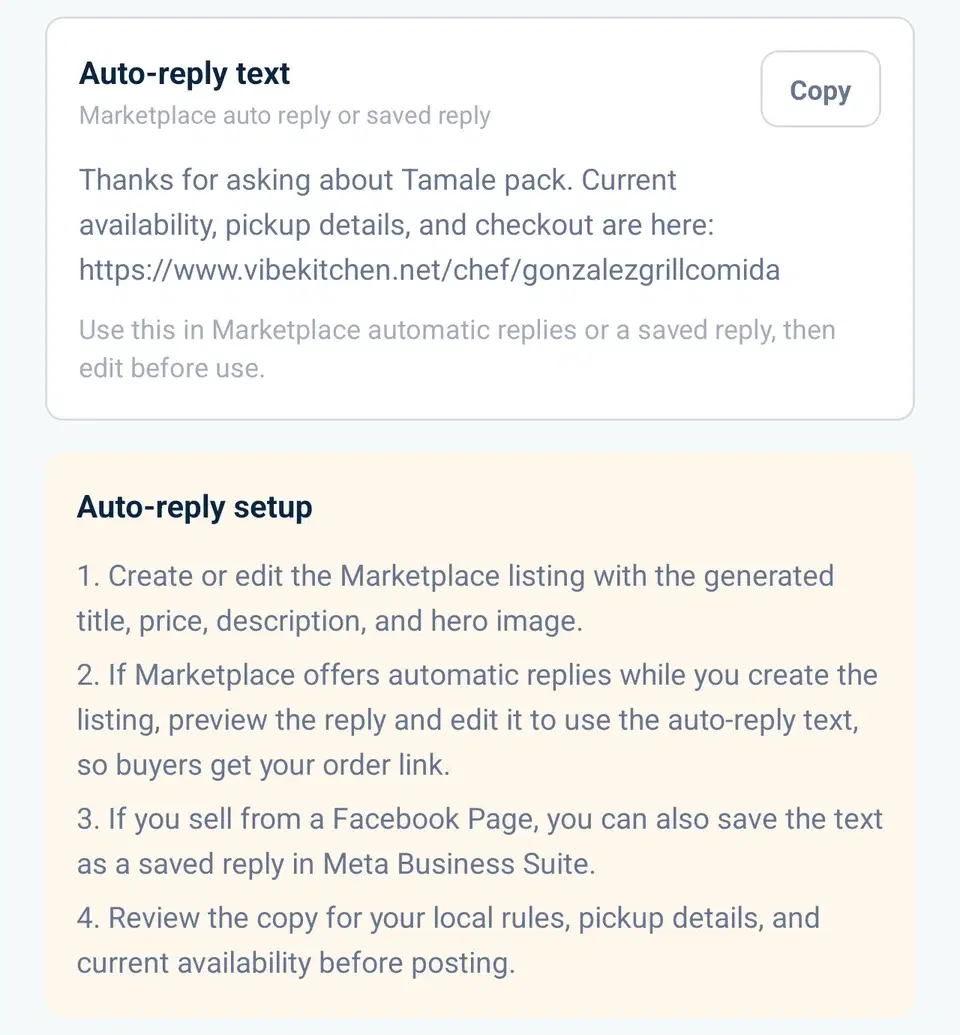
The reply
Reply text with your order link, and where to use it in Facebook.
The pattern that works for Marketplace sellers
Successful home sellers who use Marketplace in 2026 typically operate a two-step system:
- Marketplace as the discovery listing. A simple listing with photo, price, and a clear call to action — "order at [link] for Saturday pickup" or "message for custom orders over $50." The listing is a magnet, not an ordering system.
- A structured ordering page or form for actual transactions. New buyers coming from Marketplace are routed off the platform to a real ordering surface as quickly as possible. Repeat customers skip Marketplace entirely and use the ordering page directly.
This pattern is what makes it possible to sell volume through Marketplace without drowning in Messenger threads. It also builds a customer database that lives outside Facebook — if your account gets restricted, you still have your buyers' emails and phone numbers.
VibeKitchen is built for exactly this second step. A single shareable ordering link. Structured order capture with payment status, pickup time, and dietary notes in one place. Customer records that belong to you. The tool is available now on the web, iOS, and Android; the broader channel guide covers where it fits in a home-food seller's channel mix.
The best listings usually name the rhythm up front: preorder cutoff, pickup day, delivery area if offered, payment expectation, and how repeat buyers should order next time. Tamales, tres leches, lumpia, dessert trays, plate lunches, custom cakes, and holiday boxes all work better when the buyer can see the day and the order steps before opening Messenger.
The short version: list the food, send the order link, cook from the order list, get paid. Use Marketplace to get seen, then send buyers to your order page.
Marketplace seller workflow
Post the food where buyers scroll
Use a real photo, clear price, pickup area, order cutoff, and one next step.
Move details into one link
Collect item, quantity, pickup window, notes, contact, and payment/order expectation before cooking.
Make the second order easier
Send repeat buyers to the same saved link instead of rebuilding the order from Messenger each time.
What to do if your listing gets removed
If Facebook removes a food listing, the practical options:
- Do not re-post the same listing verbatim. Re-posting the exact content that was flagged usually just repeats the same platform signal. If the listing was clearly in a category Facebook dislikes, the content itself is the issue.
- Check if similar sellers in your market are posting. If similar listings are live nearby, enforcement may be variable enough that presentation matters. If the category has been broadly cleared out, the platform has probably tightened that category locally.
- Move to your ordering page and drive traffic there instead. The most durable response. Marketplace can still be a discovery surface, but your own ordering page is where the menu, order details, pickup time, payment status, and customer record belong.
- Appeal if you believe the removal was an error. Meta’s policy page links to the review process for removed Marketplace listings. An appeal does not guarantee reinstatement.
Realistic expectations
Selling home food through Facebook Marketplace in 2026 is:
- A viable path for first customers and early-stage growth
- Unreliable as a long-term foundation because a social listing is not an order system
- Most effective as a discovery channel that feeds buyers to a more structured ordering system
- Not a substitute for understanding your state's food rules and choosing the rules you want to operate under
The Instagram channel guide covers the parallel case for a different platform, with different dynamics. The state-by-state reference points to the agency that handles your food and sales method.
Is it legal in your state?
Facebook's policy is one question; your state's cottage food law is another, and it applies whether or not Facebook enforces its own rules. Whether you can legally sell a given food from home — and whether you need registration or a food permit — depends on where you live. Start with the state-by-state rules and agency links, or open a full guide: California, Florida, Texas, New York, or Ohio. For cooked plates and prepared meals, which most cottage food laws do not cover, see California's MEHKO program.
Frequently asked
Common questions.
Can you sell food on Facebook Marketplace?
As of our October 2026 check, Meta’s public Commerce Policies do not list homemade food as its own prohibited category. That is not a guarantee that a listing will stay up: Meta can remove listings under its policies, and state and local food rules apply whether a listing is visible or not.
Is it legal to sell food on Facebook Marketplace?
It depends on your state, not on Facebook. A listing Facebook tolerates can still fall outside your state's cottage food rules, and a sale your state allows can still be removed by Facebook. Shelf-stable items like baked goods and jams are the most likely to fit a state's cottage food rules; cooked plates and perishable items often sit under a different state or local path. Find your state in the comparison table, then check its food and delivery notes.
Can you sell food on Facebook Marketplace without a license?
Sometimes. Some states let you sell allowed cottage foods with no license or registration; others require you to register or hold a permit first. "Facebook allows it" and "your state allows it" are different questions — use the license checklist, then follow your state’s agency link to confirm what applies to you.
Can you sell homemade food on Facebook Marketplace?
People list homemade food there, but a visible listing does not establish permission. Meta’s Commerce Policies, checked in October 2026, do not name homemade food as a prohibited category; Meta can still remove listings. Check your state’s food rules before selling, and keep orders and pickup details in one place.