What is a VibeKitchen?
Just you, your kitchen, your cooking, and an app.
Put your menu up, send people one ordering link, and keep the order details out of scattered messages. Start for free.
The best gig delivery alternatives in 2026
The best gig delivery alternatives are not the apps with the nicest descriptions. They are the options that leave you with the most take-home pay after tips, miles, waiting time, taxes, and the week you actually want to live.
If you still want delivery work, compare DoorDash, Uber Eats, Instacart, Grubhub, Amazon Flex, Walmart Spark, Shipt, Roadie, Gopuff, and Favor. If you want flexible work without restaurant pickups, compare Rover and TaskRabbit. If the real problem is that every dollar runs through someone else's algorithm, selling your own food directly belongs in the comparison too.
That last option sounds odd until you look around. People are already posting soul food plates, pasta trays, tamales, cinnamon roll preorders, sourdough porch pickups, and meal prep menus online. Some use Facebook messages. Some use Hotplate. Some use a plain order form. VibeKitchen's angle is simple: if the demand is already there, the ordering should not live in scattered DMs.
For narrower app-specific pages, use Instacart alternatives or the deep dives is DoorDash worth it and is Uber Eats worth it. If you only want the pay ranking, start with best delivery app to make money.
Fast comparison
Start with the kind of work you are trying to replace.
| Path | Best when | Watch first |
|---|---|---|
| Restaurant delivery | DoorDash, Uber Eats, Grubhub, Favor | Dead miles, restaurant waits, tip variance |
| Grocery delivery | Instacart, Shipt, Walmart Spark | Triples, substitutions, heavy orders, tip dependence |
| Package routes | Amazon Flex, Roadie | Block access, route distance, lifting, return drive |
| Flexible non-driving work | TaskRabbit, Rover, local service work | Customer matching, skill fit, slower start-up |
| Your own food offer | One menu item, one pickup window, one week | Grocery runs, local rules, packaging, buyer messages |
Start with the money, not the app description
Most gig listicles dramatize the app in two sentences and move on. That is not enough. A driver does not pay rent with "flexibility." The comparison has to start with take-home pay and tips.
The public driver examples we reviewed are self-reported, so do not read them as a national average. Read them for the thing most app descriptions hide: app-open hours, total miles, and tip dependence change the answer fast. A $3,000 week can fall near $15 per hour after estimated mileage cost if it took about 105 app-open hours and more than 2,000 miles. A $4,500 month can look strong until 4,888 miles and 238 app-open hours enter the math. The flip side is real too: one controlled DoorDash week — $847 across about 29 app-open hours and 312 miles — held near $21.41 per hour after estimated mileage cost. DoorDash can work; it can also quietly take over the week.
We use the IRS 2026 business mileage rate as a vehicle-cost proxy because gas alone is too soft. Gas does not cover tires, brakes, depreciation, extra insurance friction, or the dead drive back to your zone. When an example has app-open hours, the better question is: what did the driver keep after the car cost, per hour the app was open?
If you want the full pay-led version of this topic, read best delivery app to make money. This page is the hub: it maps the options, then points you to the deeper page when a specific app is your next move.
Real driver examples
What the money looks like after miles are counted.
| Example | Snapshot | Time, miles, and take-home signal | Why it matters |
|---|---|---|---|
| Multi-app marathon week | DoorDash + Uber Eats, $3,076.68 gross | ~105 app-open hours, 2,041 miles, about $15.21/hr after estimated mileage cost | A huge gross number can shrink fast when the week puts that many miles on the car. |
| High-gross DoorDash month | DoorDash, $4,502.86 gross | 238.43 app-open hours, 4,888 miles, about $4.02/hr after estimated mileage cost | Gas-only math can hide the bigger vehicle-cost problem. |
| Controlled-mile DoorDash week | DoorDash, $847 gross | ~29 app-open hours, 312 miles, about $21.41/hr after estimated mileage cost | Good weeks exist, especially when miles stay controlled. |
| Tip-heavy Instacart week | Instacart, $997 gross | 46 active hours, about $18.36/hr on an active-time basis after estimated mileage cost | Tips carried the week: $562 tips vs $429 batch pay. |
| Tight Spark block | Walmart Spark, ~$72 block | ~2 hours, 17 miles, about $29.84/hr after estimated mileage cost | Spark can win when small trips stay tight. |
| High-tip Shipt order | Shipt / Target, ~$86 order | 28 round-trip miles, $50 tip after delivery | Some grocery orders work only because the tip or route timing saves them. |
How we counted it
How to read these examples.
These are public, self-reported driver examples, not a national pay average.
When miles and app-open hours were available, we converted the screenshot into an estimated net hourly number using the 2026 IRS business mileage rate.
Gas is shown only as extra context, because mileage cost already accounts for vehicle use.
Use them as sanity checks: before calling an app better, look at time, tips, miles, and the unpaid miles between orders.
Which app is closest to the one you're leaving?
If you just want the same work with a different logo, the answer is short. Apps like DoorDash come down to Uber Eats and Grubhub — the same restaurant-pickup shape, easy to test side by side. Apps like Uber Eats are those same two, except Uber keeps one trick the others cannot copy cleanly: in many markets you can flip between food delivery and rides when dinner slows down. Apps like Instacart are the odd ones out, because the nearest match is not a restaurant app at all. It is Shipt or Walmart Spark, where the work is shopping, not just driving.
Grocery and package apps — Amazon Flex, Roadie, Gopuff — are not clones of any of these, but they pull from the same pool of driver hours, so the table above ranks them alongside the rest. Once you know which app you are actually trying to escape, Instacart alternatives goes deeper on grocery, and is DoorDash worth it, is Instacart worth it, and is Uber Eats worth it help when you are still on the fence.
Or change the kind of work, not just the app
Sometimes another app is the wrong fix, because what is wearing you down is not the brand. It is the shape of the day. Jobs like DoorDash that are not DoorDash sort by the part you want gone. Tired of restaurant waits? Amazon Flex, Roadie, and Spark push you toward packages and grocery runs. Tired of being in the car at all? Rover and TaskRabbit trade driving for pet care and local tasks. Hate that every repeat customer stays locked inside someone else's app? That is the case for testing a small food offer of your own.
Jobs like Instacart split along one question: do you actually like shopping? If stores, regulars, and bigger batches suit you, Shipt and Spark keep that shape. If the aisles are the part you want gone, package routes or a home-food preorder test move you out of them. The honest caveat holds either way — if you need cash tonight, open another delivery app, because it pays faster than building demand for a menu. Selling food through pre-orders takes longer to build, but it gives you more control over price, pickup, and repeat customers. It is not emergency money. For a straight pay comparison across all of these, see best delivery app to make money.
Delivery apps to make money
If pay is the only thing you care about, compare delivery apps by net take-home, not the screenshot total. There is no national winner. The app that pays most is the one that fits your market, your car, and the hours you can actually work, and the full pay-led breakdown lives on best delivery app to make money.
The smart test is boring: run one week, track app-open hours, miles, gross pay, tips, gas, and your estimated vehicle cost. Do not use active time only. Active time is the app's flattering camera angle.
The list
1. DoorDash
DoorDash is the baseline food-delivery app for many U.S. drivers. It is fast to start, widely available, and useful in dense markets. It is also the app that sends many people searching for alternatives once low offers, dead miles, and schedule access start wearing them down.
Best fit: drivers in busy markets who can work meal windows and decline bad mileage. Deep dive: is DoorDash worth it.
2. Uber Eats
Uber Eats is the closest DoorDash substitute for restaurant delivery. It can be stronger for drivers who also qualify for Uber Rides because the app gives them more ways to chase demand during slow food windows.
Best fit: drivers in mid-to-large markets who can switch between delivery and rides. Deep dive: is Uber Eats worth it.
3. Instacart
Instacart is grocery shopping and delivery, so the work is slower and more physical than restaurant delivery. The upside is bigger batches and tip-heavy weeks. The downside is substitutions, heavy loads, and long batches that make active-time screenshots look easier than the day felt.
Best fit: shoppers who like stores and can handle heavier orders. Deep dive: is Instacart worth it.
4. Grubhub
Grubhub is still useful as a third app in markets where it has order flow. It is rarely the entire answer by itself, but it can fill gaps for drivers already running DoorDash and Uber Eats.
Best fit: multi-app drivers who want extra restaurant volume.
5. Amazon Flex
Amazon Flex is package delivery built around reserved blocks. You trade some flexibility for schedule predictability. No tips to chase, but also less chance of a surprise high-tip night.
Best fit: drivers who want blocks, packages, and fewer restaurant waits.
6. Walmart Spark
Walmart Spark deserves a place in the 2026 comparison. It competes with Instacart, Shipt, DoorDash grocery, and Amazon Flex for drivers who are willing to shop, deliver, or handle curbside grocery orders.
Best fit: drivers near active Walmart stores, especially where driver supply is thin.
7. Shipt
Shipt is grocery shopping and delivery with a different customer base than Instacart. It can be better in Target-heavy markets and weaker where order density is thin.
Best fit: shoppers who like repeat customers and grocery routines.
8. Roadie
Roadie is package and item delivery, not restaurant delivery. It can work well for larger items, longer routes, and drivers who want to be picky about trips.
Best fit: drivers who want package-style gigs and can judge per-mile value quickly.
9. Gopuff
Gopuff is convenience delivery from micro-warehouse style locations. It is steadier than restaurant delivery in some cities, but the hourly ceiling can be lower.
Best fit: drivers who prefer predictable pickup points and less restaurant chaos.
10. Favor
Favor is Texas-focused and owned by H-E-B. It can be a useful regional alternative where it has demand and a strong customer base.
Best fit: Texas drivers who want another app in the rotation.
11. Rover
Rover is not delivery. It belongs here because many drivers are really searching for flexible work, not another bag of restaurant orders.
Best fit: people who like pet care and want less car wear.
12. TaskRabbit
TaskRabbit is local task work: assembly, moving help, repairs, errands, and similar jobs. It has more customer friction than delivery apps, but skilled taskers can set higher rates.
Best fit: people with practical skills who want a higher ceiling than per-order driving.
13. Sell your own food directly
Selling your own food is not a gig app. It is a small food offer with your own buyers: plates, trays, desserts, breads, meal prep, tamales, lunch plates, or a one-item weekly menu.
The proof is in how many people already do it: deposits on plate listings, tamale orders over Venmo, barbecue preorders, dessert preorders that sell out in an afternoon. A first test does not have to be a full bakery. Pick one thing you know you are great at and test only that for one week.
Start with how to sell food online, then check cottage food law before assuming your food, state, city, or delivery method is allowed. If baking is your path, use home bakery.
App-by-app
The 2026 alternatives at a glance.
| Option | Best for | Startup | Tips | Main downside |
|---|---|---|---|---|
| DoorDash | Dense markets, meal windows | Fast | Medium-high | Dead miles, low offers |
| Uber Eats | Urban demand, or switch to Uber rides | Fast | Medium-high | Cross-town offers |
| Instacart | High-tip stores, tight batches | Fast | High | Triples, subs, heavy loads |
| Grubhub | Extra restaurant volume as a third app | Fast | Medium | Thin on its own |
| Amazon Flex | Scheduled blocks, packages | Medium | None | Scarce blocks, lifting |
| Walmart Spark | Close stores, thin-driver zones | Fast | Medium-high | Curbside waits, tip clearing |
| Shipt | Target markets, repeat customers | Medium | High | Thin density, long drives |
| Roadie | Larger items, longer routes | Fast | Low | Uneven volume |
| Gopuff | Fixed pickup, steady runs | Fast | Low-medium | Lower hourly ceiling |
| Favor | Texas markets | Fast | Medium | Regional only |
| Rover | Pet care, less car wear | Medium | Low | Not delivery; build demand |
| TaskRabbit | Practical skills, higher rates | Medium | Low | Customer friction, matching |
| Sell your own food | You already have buyers | Build demand first | None — you set your price | Grocery runs, local rules |
What selling food directly looks like
The first step usually looks less polished than people imagine. A seller posts a flyer, names the menu, asks for a deposit, sets a pickup or dropoff plan, and answers messages. That proves demand. It also creates a mess: scattered messages, unclear quantities, manual deposits, no clean customer list, and people asking "is this still available?" after you sold out.
That is where an ordering page matters. VibeKitchen is meant for the part after the first proof. Its main mode is Made to Order: a buyer places an order and you cook it to order, the same rhythm as filling delivery runs, except the customer and the full ticket are yours. You can also sell Ready Now items or take preorders for a set pickup day. One menu, your pickup or delivery settings, and a notify-me list instead of a buried inbox.
Be honest about the work. You are going to the grocery store a lot more. You are also going to package food, answer questions, manage pickup windows, clean up, and learn which local food rules apply to your menu. The upside is control. The work is real.
Demand proof
Menu posts are already doing the first job.
The Facebook examples show the messy first step: menu graphic, price, deposit, pickup or dropoff, and message thread. The VibeKitchen screens show what changes after demand exists: made-to-order and ready-now items, fewer missed orders, clear pickup details, and one customer list.
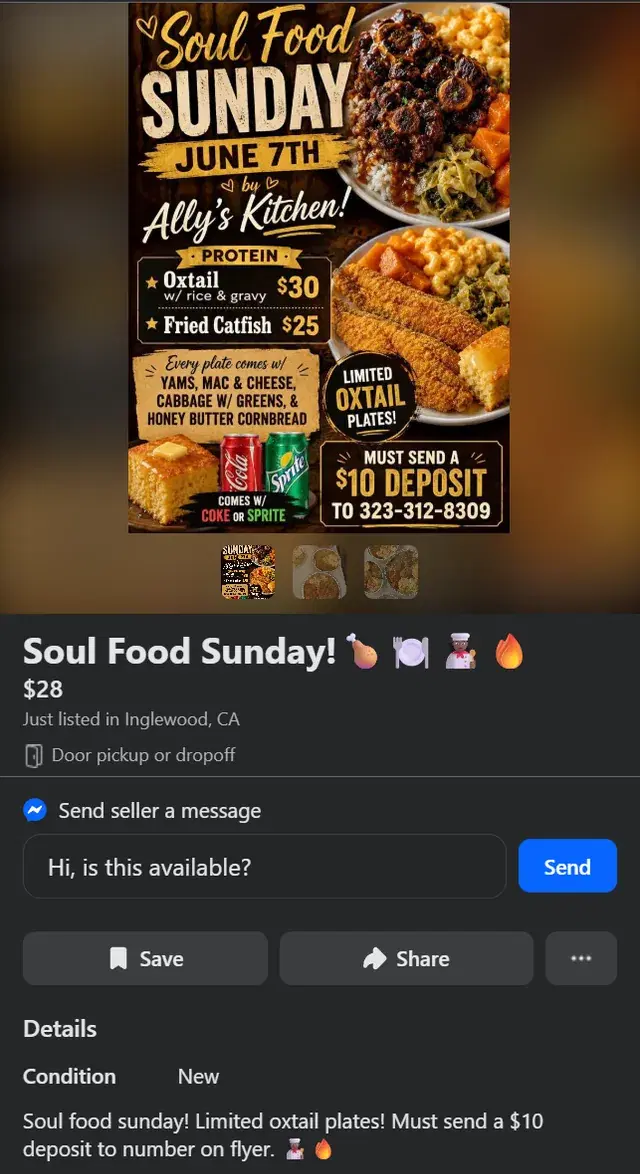
Public menu post
A soul food listing with plate prices, a $10 deposit note, pickup/dropoff language, and messages as the order path.
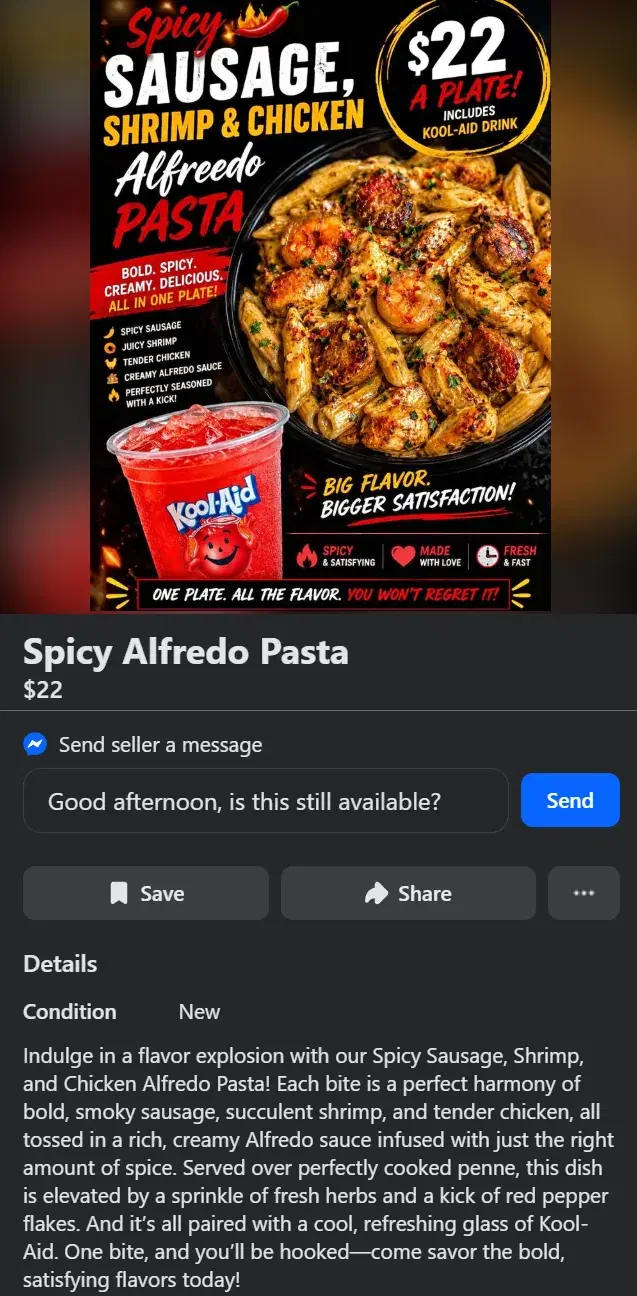
Plate offer
A $22 pasta plate offer with a menu graphic and buyer message box. Demand can start this simply.

Seller storefront
Pickup, delivery fee, hours, seller identity, and made-to-order items in one mobile storefront.
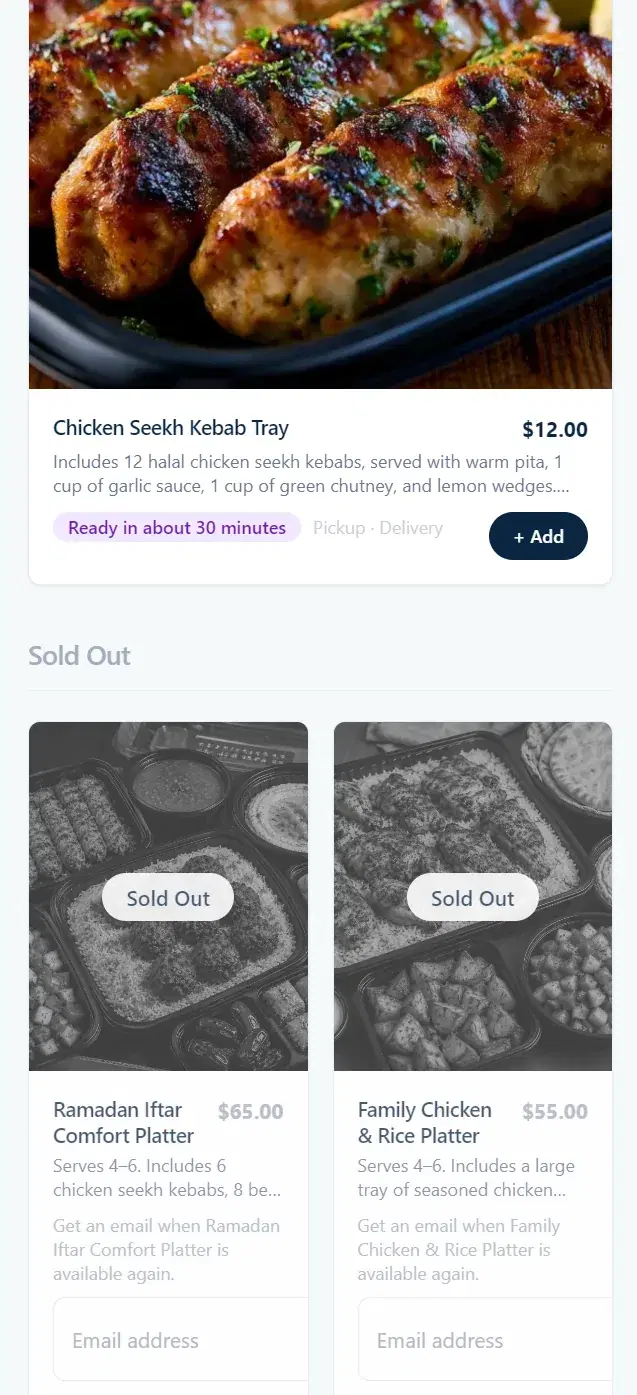
Order flow
Item price, add button, sold-out state, and notify-me capture replace scattered DMs.
Home food examples
Real examples, not promises.
| Example | What happened | Why it matters | Keep in mind |
|---|---|---|---|
| Sarah's Sourdough | $37k first-year revenue; baked-goods margins described around 75% | Proof that a small cottage bakery can grow from porch pickup into real revenue | Approximate margin, not a formal P&L |
| Caroline Bower | $5,364.95 October revenue; original loaves implied $10 each | Monthly microbakery operating example with product/channel detail | Costs were not reported |
| Gooey Center | 500+ rolls/week; modeled $4,750+/week at $9.50 classic roll price | Preorder scale when ordering and pickup are organized | Modeled from public price plus case-study volume |
| Millbrook BBQ plate sale | Capacity revenue: $8,400 if 120 Boston butts and 200 plates sold | Plate-sale pricing, quantity cap, preorder, and pickup window | Capacity, not confirmed sell-through |
| Keto bakery projection | Projected 44.5% COGS and 41.5% net before tax/savings/reinvestment | A realistic first-menu math example | Projected, not actual performance |
How to choose honestly
If you need money tonight, download another app. DoorDash, Uber Eats, Instacart, Spark, Shipt, and Amazon Flex are faster than building demand for a menu.
If you already cook for friends, coworkers, church groups, school parents, or local events, test one food offer. One item. One week. One pickup window. Track gross sales, ingredient cost, packaging, time, and no-shows. The goal is not to quit gig work in seven days. The goal is to see whether buyers exist without an app dispatching orders to you.
If you are staying in delivery, run the same test on the apps. One week, same notebook. App-open hours, active hours, gross pay, tips, miles, gas, and your estimated mileage cost. The app that wins is not always the app with the highest gross. It is the one that fits your market, your car, and your patience.
Test the option like an operator
Track the app
Count gross pay, tips, app-open hours, total miles, gas, and estimated mileage cost.
Test one food offer
Pick one thing you already make well. One item, one pickup window, one week.
Compare the rhythm
Gig apps pay faster. Preorders take more planning but give you price control and let you keep your customers.
Methodology and source notes
The driver-pay examples in this guide series use public self-reported Reddit posts and screenshots from DoorDash, Instacart, Shipt, Spark, Uber Eats, and multi-app drivers. They are not a scientific sample. They are useful because many include details that generic app articles skip: app-open hours, mileage, batch counts, tip splits, and driver comments about how the week actually worked.
For vehicle cost, we use the IRS 2026 business mileage rate as a proxy when miles are available. That means gas is not subtracted twice. Gas is shown as context; mileage cost is the broader car-cost lens.
For home-food examples, we separate actual reported revenue from modeled economics. Public sources include Sarah's Sourdough, Caroline Bower's microbakery recap, Hotplate's Gooey Center case study, a Millbrook BBQ plate sale, Missoula tamale preorder posts, and public plate-sale flyers. These examples show behavior, not legal permission. Always check your local rules before selling food.
Source discipline
How to read the numbers without fooling yourself.
Driver examples
Use them as real examples, not national averages. Self-reported screenshots can be incomplete.
Mileage cost
The IRS-rate lens includes more than gas. Do not subtract gas again when using it.
Tips
Tip-heavy weeks can be real, but they are not guaranteed base pay.
Food examples
Public menu posts prove behavior. Local food rules still decide what a seller can do.
Frequently asked
Common questions.
What are the best apps like DoorDash?
The closest apps like DoorDash are Uber Eats, Grubhub, Favor in Texas, and Postmates legacy accounts. If you are open to grocery or package delivery, compare Instacart, Shipt, Walmart Spark, Amazon Flex, Roadie, and Gopuff too.
What are the best jobs like DoorDash?
Jobs like DoorDash include Uber Eats, Grubhub, Amazon Flex, Walmart Spark, Roadie, Instacart, Shipt, TaskRabbit, Rover, and local courier work. If the real problem is app control, test a small food offer before adding more driving hours.
What is a good Instacart alternative?
For shoppers, the closest Instacart alternatives are Shipt, Walmart Spark, DoorDash grocery, Uber Eats grocery, Amazon Flex, and Roadie. For grocery customers, the answer may be Shipt, Walmart Grocery, Amazon Fresh, DoorDash, Uber Eats, Gopuff, or a local grocery service.
What jobs are like Instacart but not grocery shopping?
Amazon Flex, Roadie, TaskRabbit, Rover, local courier work, and selling your own food directly are better comparisons if you want flexible work but do not want to shop grocery orders.
Which delivery apps make the most money?
It depends on market density, tips, miles, and wait time. DoorDash, Uber Eats, Instacart, Amazon Flex, Walmart Spark, Shipt, Roadie, and Grubhub can all work in the right zone. Track take-home pay after estimated vehicle cost, not just app screenshots.
Is selling your own food a real gig delivery alternative?
It can be for people who already cook and have a local network. It is not fast cash, and it is not legal for every menu or sales channel in every place. Test one item for one week, track the money, and check local food rules before taking paid orders.
Where these numbers came from (12)
Every figure on this page is a real, self-reported example, not a national average. Driver weeks come from public Reddit posts; home-food revenue comes from public business recaps and listings. We applied the 2026 IRS business mileage rate as the vehicle-cost lens.
- DoorDash + Uber Eats, $3,076.68 week — r/doordash_drivers (self-reported)
- DoorDash, $4,502.86 month, Little Rock AR — r/doordash_drivers (self-reported)
- DoorDash, $847 week — r/doordash_drivers (self-reported)
- Instacart, $997 week with $562 in tips — r/InstacartShoppers (self-reported)
- Walmart Spark, ~$72 block — r/Sparkdriver (self-reported)
- Shipt, ~$86 order with a $50 tip — r/ShiptShoppers (self-reported)
- Sarah's Sourdough, $37k first-year revenue — sarahssourdough.com
- Caroline Bower, $5,364.95 in October — carolinebower.com
- Gooey Center, 500+ rolls/week — Hotplate case study
- Millbrook BBQ plate sale — Elmore-Autauga News
- Keto home-bakery projection — r/smallbusiness
- 2026 IRS business standard mileage rate (vehicle-cost lens) — IRS.gov