Free tool
Baked goods pricing calculator
Enter your real batch numbers and get a cost-plus price per item. It counts the costs most home bakers forget — packaging, labor, and overhead — so you price above cost, not just above ingredients.
A 40% markup is about a 29% margin. For a true X% margin, divide cost by (1 - X / 100).
Preset numbers are illustrative examples. Replace them with your own costs.
Price breakdown (per item)
Suggested price per item
$3.75
Item price rounded to the nearest quarter. Batch of 24 sells for $90.00.
A starting number, not a market cap. If your market will not pay it, simplify the product before you drop below cost.
Baked goods price sheet
Inputs
- Ingredient cost per batch
- $18.00
- Batch yield
- 24
- Packaging per item
- $0.35
- Labor hours per batch
- 1.5
- Hourly labor target
- $20.00
- Overhead
- 15%
- Markup on cost
- 40%
Price breakdown (per item)
- Ingredients
- $0.75
- Packaging
- $0.35
- Labor
- $1.25
- Base cost per item
- $2.35
- Overhead
- $0.35
- Total cost per item
- $2.70
- Suggested price per item
- $3.75
- Batch total
- $90.00
Source: vibekitchen.net/pricing-baked-goods-calculator
The simple formula
Price each item to cover ingredients, packaging, labor and overhead, then add a markup on that cost. Use the calculator above to enter your costs and print or share the result.
- Batch costs: ingredients and the time to make, pack and clean up.
- Per-item costs: packaging and a share of batch costs.
- One-off cake design: a separate charge for that order.
For the menu, scheduling and startup checklist, read how to start a home bakery.
How to price baked goods, step by step
- Cost the recipe by the amount of each ingredient used.
- Divide ingredient cost by the actual batch yield.
- Add packaging: bags, boxes, liners, labels and boards.
- Count mixing, decorating, packing, cleanup and message time.
- Add an overhead allowance for utilities, equipment wear and waste.
- Choose a markup on cost, then check the rounded selling price.
Compare local products with similar size and finish. If buyers will not pay a price that covers your work, try a simpler design or a smaller menu before cutting your labor target.
Baked goods pricing calculator
The calculator uses this cost-plus formula. Cake design time gets the same overhead and markup, then is added once to the order total.
| Step | Calculation |
|---|---|
| Ingredients per item | batch ingredients / yield |
| Labor per item | hours x rate / yield |
| Base cost per item | ingredients + packaging + labor |
| Overhead per item | base cost x overhead % |
| Total cost per item | base cost + overhead |
| Price before rounding | total cost x (1 + markup %) |
Markup is a percentage of cost; margin is a percentage of selling price. For example, 40% markup gives a margin of 40 / 140, or about 29%. For a true X% margin, divide cost by (1 - X / 100).
Calculator worksheet
Use the cookie example below to check your inputs. These are illustrative costs, not market prices: $18 ingredients, 24 cookies, $0.35 packaging each, and 1.5 hours at $20/hour. Base cost is $56.40 per batch, or $2.35 each before overhead and markup.
Replace each input with a receipt, a measured yield or your own labor target. The default calculator adds 15% overhead and 40% markup, then rounds each cookie to $3.75 for a $90 batch.
Illustrative worksheet
Cookie batch pricing example
| Item | Input | Math |
|---|---|---|
| Ingredients | $18 per batch | $18.00 total |
| Packaging | $0.35 x 24 cookies | $8.40 total |
| Labor | 1.5 hours x $20/hour | $30.00 total |
| Base cost | $18 + $8.40 + $30 | $56.40 per batch |
| Per cookie | $56.40 / 24 cookies | $2.35 each |
| Overhead and markup | +15%, then +40% | $3.78 each |
| Rounded price | Nearest quarter | $3.75 each, $90 batch |
Quick examples
| Product | Costs to check |
|---|---|
| Dozen cookies | dough, icing, bags, labor |
| Cupcakes | batter, frosting, liners, box |
| Bread loaf | ingredients, bag, active labor |
| Custom cake | servings, boards, design, transport |
| Market tray | packaging, stall fee, waste |
Add the costs people forget
- Packaging: include inserts, ribbons, labels and cake boards.
- Admin: count time spent agreeing to a design and arranging pickup.
- Waste: allow for test batches, breakage and unsold market stock.
- Transport: include mileage and delivery or setup time when offered.
A structured bakery order form helps capture requests that change the price before you agree to the order.
Worked examples
A shared production day spreads batch labor across the goods you actually make. One-off customization still belongs to the buyer who requested it. Use the matching preset above and compare your own costs across these situations.
Pricing situations
Different bakery products need different math.
Custom cakes
Separate base servings from design labor, filling, delivery, consultation, and rush timing.
Decorated cookies
Theme complexity, colors, drying time, packaging, and pickup date pressure change the price.
Preorder menus
One production day spreads labor across many buyers, but unsold product risk still belongs in the math.
Marketplace sales
Message labor and price comparison are real costs. Clear listings and order forms reduce hidden admin time.
Cake pricing
Choose Custom cake in the calculator above. Enter servings as the yield. The base serving price covers ingredients, packaging, batch labor, overhead and markup. Enter sketching, color matching and decoration in Design time per order. The calculator prices those hours like batch labor, with the same overhead and markup, and adds them once to the order total.
To quote a wedding cake, write down:
- Servings and tiers: confirm portion size, cake sizes and structural supports.
- Flavor and finish: cost the filling, frosting, boards and decorations.
- Design time: include planning, messages and hands-on decoration once.
- Delivery or setup: add the actual travel and venue work to your quote separately; the calculator has no delivery field.
Do not judge a sculpted cake by servings alone. Keep the base cake price and the order's design charge visible so a change in decoration has a clear cost. Record the agreed details in your own cake order form.
Cookie pricing
Choose Cookies (dozen) in the calculator above for a twelve-cookie example. Replace the dough, icing and packaging inputs, then time the whole job. Until you pick a preset, the calculator shows the two-dozen batch from the worksheet above.
- Count each icing color and decorating pass in batch labor.
- Include individual wrapping, labels and ribbon in packaging per cookie.
- Divide by saleable cookies; broken or test cookies still cost money.
The result is a price per cookie and a total for the selected yield. Use the batch total when quoting a dozen.
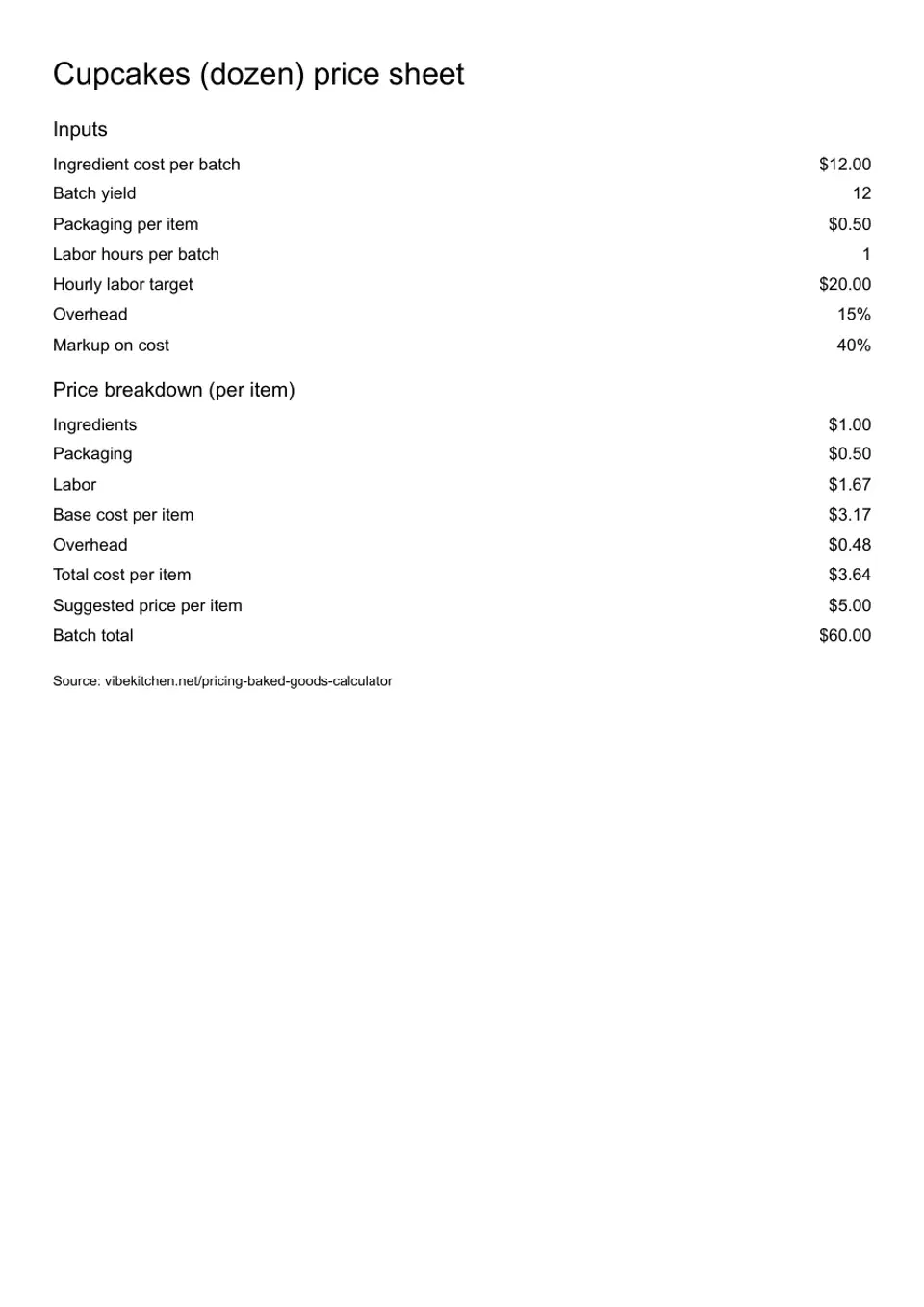
Cupcake pricing
Choose Cupcakes (dozen) in the calculator above. Enter frosting and filling in the ingredient total, and divide the box and insert cost across the cupcakes it holds.
- More flavors can mean separate mixing and washing time.
- Filled centers, piped flowers and toppers add materials and labor.
- Half-dozen boxes can cost more per cupcake to package than larger orders.
Use Print price sheet to keep the current breakdown. Uncheck Include source line to print it without our web address. Example values are illustrative, not suggested market prices.
When to raise prices
Review prices when ingredients or packaging change, custom work takes longer than planned, or a full order book leaves too little after paying yourself.
- Recalculate the product using current costs and timed labor.
- Check portions and design scope before changing the price.
- Update every menu and confirm the price with each new order.
Frequently asked
Common questions.
What is the easiest baked goods pricing formula?
Add ingredients, packaging, labor and overhead, then apply a markup on cost. Divide batch costs by yield when pricing individual items.
Should I price by ingredient cost only?
No. That leaves packaging, your time, overhead and customer communication unpaid.
How do I price custom cookies?
Choose the cookies preset, enter your dough and icing costs, then count decorating time and wrapping. Quote the batch total for the number of cookies ordered.
Is there a free pricing baked goods calculator?
Yes. Use the calculator above, choose a preset and replace the example costs. You can print a price sheet or copy a link to reopen the calculation without signing up.
How do I use a cake price calculator?
Choose Custom cake, enter servings and base costs, then add design hours separately. The order total adds design time once, with the same overhead and markup as batch labor. Add delivery or venue setup to your own quote if offered.
What should I charge for labor when pricing baked goods?
Use an hourly target that pays for your time. Include preparation, cleanup, packing and messages as well as baking and decoration.
What is a good profit margin for baked goods?
There is no single target that fits every product. Check what remains after ingredients, packaging, overhead and paying yourself for labor. Food-cost percentage alone does not tell you whether a time-intensive cake is profitable. Markup and margin measure different things; this calculator uses markup on cost.
How do I price baked goods for a farmers market?
Include transport, stall fees, setup and selling time, packaging and unsold stock as well as production costs.
How often should I update prices?
Recheck when supplier prices change or your recorded labor differs from your estimate. Use recent receipts and actual yields.